
So here we are starting with my first blog post today. From now on I will provide you with regular updates on current developments of financial markets and how they affect my portfolio strategy.
With this blog I strive to provide investors with an overview on what is the current status of financial markets and what are the key developments and drivers. As I am an economist from my educational background and finance and investment professional from my work experience, I am taking on a long-term, macro-perspective.
My investment assessments are usually based upon a fundamental analysis, identifying key macroeconomic drivers and industry movers for stock markets to identify the current market phase and when to invest, and looking at company specific information to determine the right investment opportunities.
In this post today I will focus on the macro-economic environment and the current market phase for stock markets. Let’s start for that with looking at the development of the major US and German indices since the beginning of the year. In below graph DJI represents the Dow Jones, GSPC the S&P 500 and GDAXIP the price index of the German Dax. These are the stock markets which are most interesting for me, based on my etoro investment portfolio, so this is why I am focusing on them now.
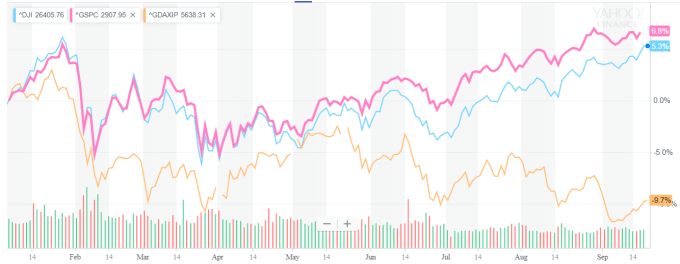
It is visible that while there has been a severe turndown in stock markets at the beginning of the year of around 10%, US markets stayed volatile throughout the year but in the end, both, the Dow Jones, which covers the large blue chip companies, as well as the S&P, which covers the broader stock market, recovered significantly. This does not hold true for the German blue chip index DAX, however, that experienced the same slump at the beginning of the year but then started progressing in a volatile downward movement.
There have been plenty of reasons for the Dax to underperform its US peers. Some of them are due to company specific situations. As the index is composed of a limited number of stocks (30) only, company-specific factors can largely influence the overall index. E.g. companies such as Commerzbank are still struggling to find a viable business model within Germany, and heavy-weights such as Bayer, Daimler and Siemens were facing their own difficulties. But also, macroeconomic risks, such as the mingling Brexit, the ongoing economic problems in Southern Europe as well as the US-China trade-tariff are posing heavy risks on the future development of the export-driven German economy.
Overall, it is fair to say that focusing on US markets this year has so far yielded much better results than focusing on German stock markets. And this development may prevail throughout the rest of the year. Still investment potential in Germany remains, if stocks are selected carefully. E.g. companies such as Qiagen N.V. (FRA: QIA), a provider of technologies for molecular diagnostics, rallied by 24% since the beginning of the year.
This is it for now. I hope you enjoyed the read and found it useful. Please also feel free to leave me a comment.
Wish you a good day and happy investing!
Best,
Marius
 etoro investor lounge